Key Takeaways
- Safety First: Slip resistance is the primary objective for sports hall restoration, meeting BS EN 14904 standards.
- Precision Marking: Court lines must be applied with laser-guided precision between the second and third coats of lacquer.
- Industrial Scale: Heavy-duty machines like the Bona Belt and Bona Flexisand are essential for large-scale timber levelling.
- Minimal Disruption: Phased scheduling during school holidays ensures facilities remain operational when needed.
For any educational institution or leisure centre in the UK, the sports hall floor is often the single most expensive asset in the building. Whether it is a classic Junckers solid maple system or a heavy-duty oak strip floor, these surfaces are subjected to immense stress. From high-intensity HIIT classes to weekend five-a-side football leagues, the constant friction, perspiration, and footwear scuffs take a heavy toll. Over time, even the most magnificent timber floor will lose its grip, its sheen, and its safety compliance.
The Problem: The Danger of the ‘Slippery’ School Hall
The primary concern for any school bursar or facility manager is liability. A wood floor that has lost its slip resistance is a significant hazard. In the damp British climate, moisture can be tracked in from playgrounds, and when combined with a worn-out, ‘buffed-to-death’ finish, it creates a surface as slick as an ice rink. Furthermore, court markings for basketball, badminton, and netball often fade into obscurity, leading to disputes during matches and a general sense of neglect that reflects poorly on the institution.
Many facilities try to solve this with frequent ‘over-mopping’ or using cheap floor polishes. This only aggravates the problem. Cheap polishes build up in thick, yellowing layers that trap dirt and actually reduce the natural flexibility of the timber. This can lead to the grain becoming brittle and eventually splintering—a nightmare for pupils in PE kits.
Agitation: The Cost of Neglect and VAT Implications
If you ignore the signs of wear, the timber eventually reaches a point where it can no longer be ‘saved’ by a simple screen and recoat. If the finish wears through to the bare wood, perspiration and cleaning water will penetrate the grain, causing deep grey staining and potential rot. At this stage, you aren’t looking at a restoration; you’re looking at a full replacement. For a standard four-court sports hall, this can cost tens of thousands of pounds plus VAT.
Furthermore, an uninspiring, dark, and scuffed hall can impact pupil morale and even the ability to hire out the space to local community groups. Many Kent and London schools rely on hall hire for additional revenue—if your floor looks third-rate, you cannot charge top-tier rental rates.
The Solution: Technical Restoration for High-Performance Athletics
A professional wood floor restoration for a sports hall is a highly technical undertaking that requires specialized tradesmen and equipment. We don’t just ‘sand’ the floor; we re-engineer the surface for maximum performance.
1. Industrial Sanding and Levelling
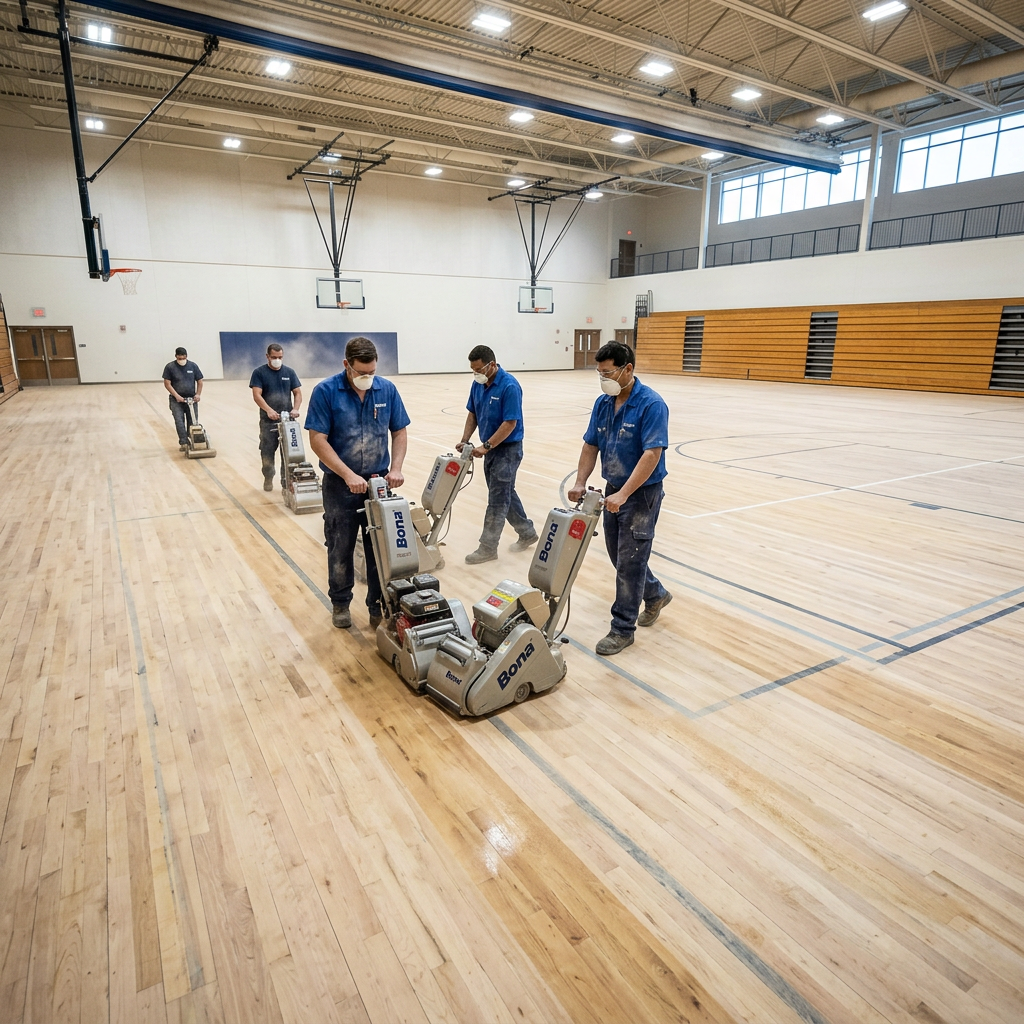
For large-scale projects, we deploy a fleet of Bona Belt sanders. These machines are balanced to provide perfectly flat results across thousands of square feet. We typically start with a 36 or 40-grit pass to remove the old, failed finish and any superficial scratches. Because sports floors must be perfectly level for fair play, we use cross-grain techniques to ensure no ‘waves’ or chatter marks remain in the timber.
2. Precision Court Line Marking
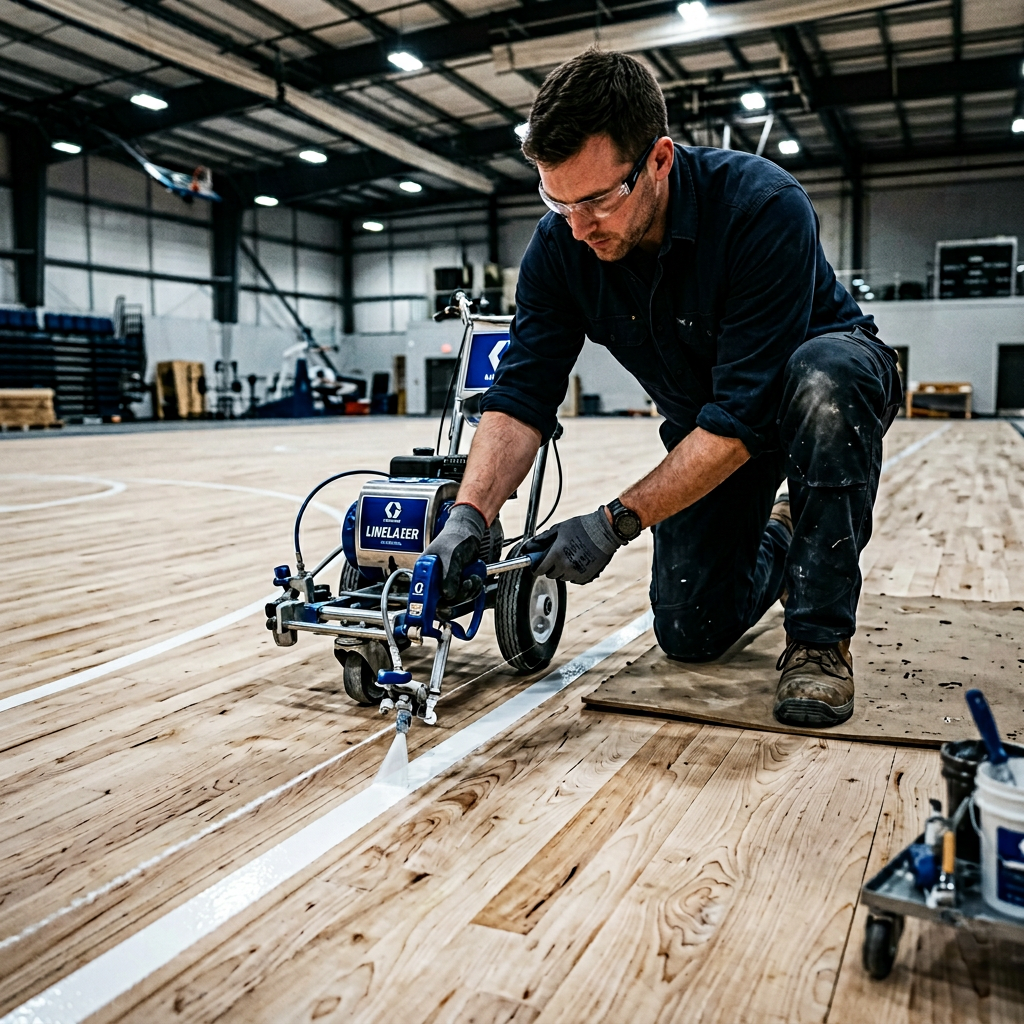
This is where art meets science. After the floor is sanded to a 100-grit finish and the first two coats of primer/lacquer are applied, we layout the court lines. Using specialized 2-component paints, we mask and apply markings for all major indoor sports. These lines are applied beneath the final coats of lacquer, ensuring they never peel or wear away underfoot.
3. High-Performance Lacquering
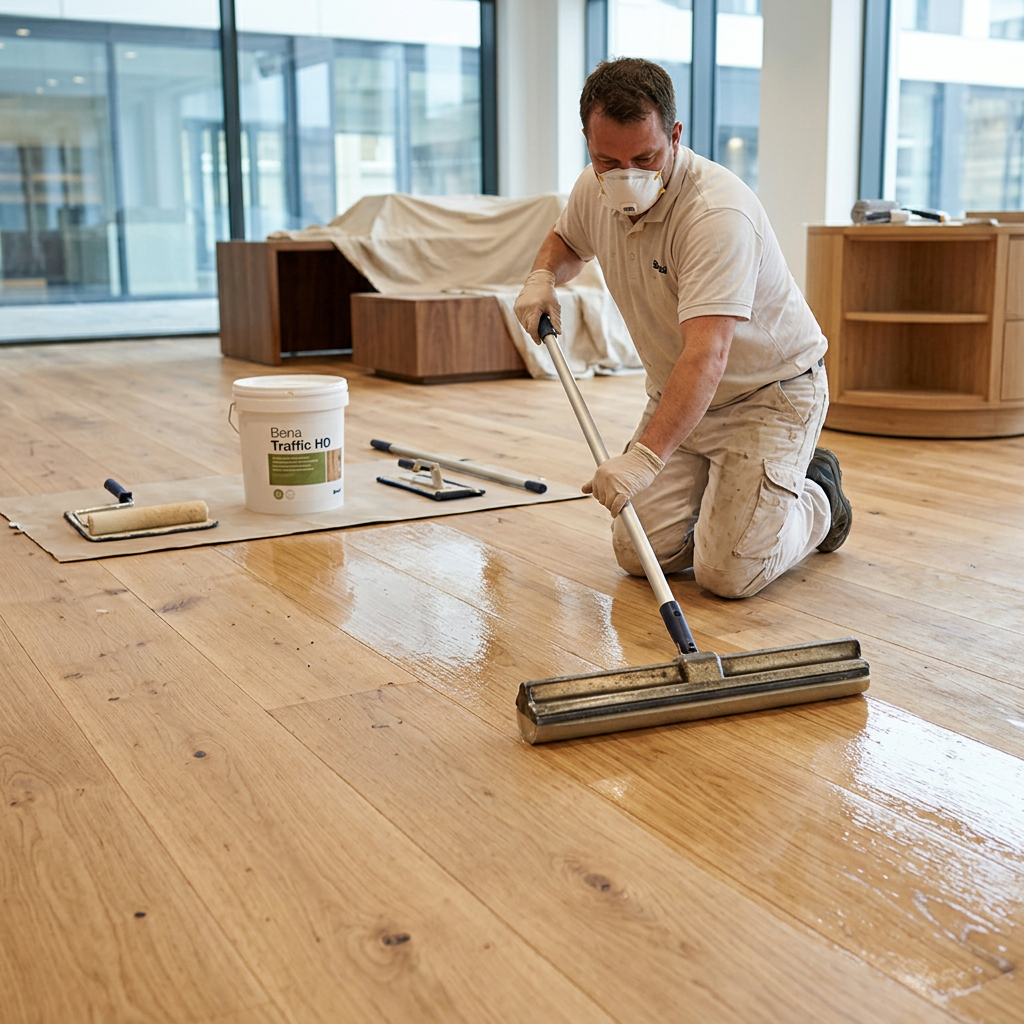
For the final finish, we exclusively use Bona Traffic HD Anti-Slip. This system is designed specifically for commercial and sports environments. It provides a high-friction surface that meets the stringent requirements of the Sports England and NWFA guidelines. It is incredibly fast-curing, allowing the hall to be returned to full use in a fraction of the time required by traditional oil-based systems.
Pro-Tip: Never use a domestic-grade lacquer on a sports hall. The friction requirements are entirely different, and a domestic finish will likely lead to injuries and premature failure.
Working Around the School Calendar
We understand that a sports hall is the heart of a school. That is why we offer flexible scheduling, including night shifts and weekend work, though most major restorations are timed for the summer or half-term holidays. Our dust-free technology means that other trades can work in the building simultaneously without fear of contamination.
Conclusion
A professionally restored sports floor is more than just a surface; it is a commitment to excellence and safety. By investing in a technical sanding and refinishing programme, you protect your capital investment, reduce maintenance costs, and provide a world-class environment for your athletes and pupils.
For more information on our commercial floor sanding solutions, or to see examples of our recent timber revivals, explore our site. You can also view our guideline pricing for commercial projects. For detailed technical specifications on Junckers sports systems, we recommend visiting the Junckers UK site.
Don’t wait for an accident to happen. Contact our specialist team today for a free technical survey of your sports hall or gym floor.